Your first steps. Your everyday Korean.
LEARN KOREANTHROUGH REALLOCAL LIFE
From your first Hangul letters to a friendly conversation. Learn with clear English explanations, useful phrases, and local context.
Made for beginners. Learn one small step at a time.

Find your starting point
LEARN AT YOUR LEVEL
Choose a comfortable starting point. These paths describe the lessons, not a formal placement-test result.
Beginner
54 published lessons
Start from your first lettersLearn consonants, vowels, syllable blocks, and the phrases you can use in a first conversation.
Start with ㄱ, ㄴ, ㄷ Browse beginner lessons →Intermediate
35 published lessons
Connect ideas and keep a conversation goingFor readers who know Hangul and basic sentences. Practise connected grammar and explain more of what you mean.
Explore reasons and results Browse intermediate lessons →Advanced
31 published lessons
Read closely and express nuanceFor confident readers. Work with longer texts, qualifications, register, and the strength of an argument.
Try a close-reading lesson Browse advanced lessons →A clear place to begin
YOUR FIRST STEPS IN KOREAN
New to Korean? Follow these guides in order.
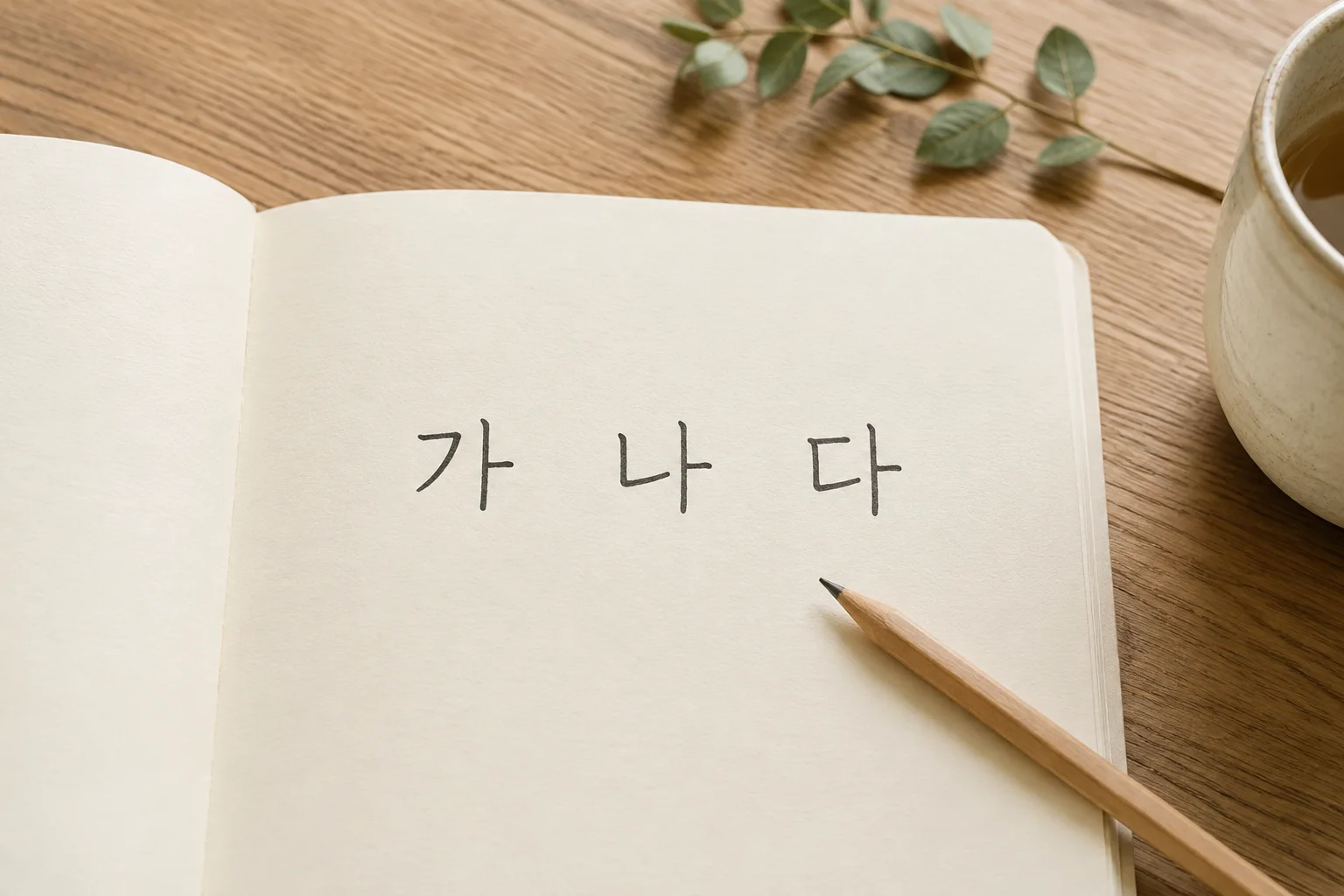
START WITH ㄱ, ㄴ, ㄷ
Recognise fourteen consonants and hear the difference between letter names and syllable sounds.
Learn the consonantsMEET THE KOREAN VOWELS
Tell similar vowel shapes apart, hear their sounds, and read them in simple syllables.
Learn the vowelsBUILD YOUR FIRST SYLLABLES
Put consonants and vowels beside or below each other, then read your first whole words.
Build a syllableNext: learn batchim, the consonant at the bottom. Already reading comfortably? Choose Intermediate above.
BROWSE THE LESSON LIBRARY
Explore all 120 published lessons. Choose a topic and level, then work through the examples and explained practice.
Study essentials
Build a study routine and use dictionaries, listening and writing practice.
- Start learning Korean: a simple path for beginners Beginner
- Korean numbers for beginners: when to use each number system Beginner
- Korean listening practice for beginners: a short routine you can try now Beginner
- Remember Korean vocabulary: a small recall-and-review routine Beginner
- Write a Korean learning journal: a short entry you can improve Intermediate
- Korean vocabulary roots: use Hanja to check meaning in context Advanced
- Short Korean dictation: hear the ending, write the message and check it Intermediate
- Korean self-study: use a dictionary to find verb forms and the right meaning Intermediate
- Business Korean vocabulary: report plans, progress and completed work Advanced
- Korean dates and days: confirm an appointment time Beginner
- TOPIK II writing strategies: separate facts, comparisons and opinions Advanced
- How to improve Korean listening skills: a three-pass practice routine Intermediate
- Korean self-study roadmap for beginners: a 30-minute weekly loop Beginner
- TOPIK I exam preparation guide: build a listening and reading study plan Intermediate
- Korean classroom phrases for beginners: ask, repeat and understand Beginner
- How to read Korean news headlines: restore the missing sentence carefully Advanced
- Korean media literacy: separate 사실, 의견, 추측 and 근거 Advanced
- 커피 나왔습니다: Korean Service Honorifics and Common Mistakes Advanced
Learn Hangul
Read letters, syllables and words in a clear sequence.
- Hangul basics: read your first Korean syllables Beginner
- Batchim for beginners: the consonant at the bottom Beginner
- Build your first Korean syllable blocks: 가, 나, 다 Beginner
- The 10 basic Korean vowels: shapes, sounds, and reading practice Beginner
- The 14 basic Korean consonants: start with ㄱ, ㄴ, ㄷ Beginner
- Combined Korean vowels: read 애, 에, 와, 워, 위 and 의 Beginner
- How to write Hangul: stroke order and your first handwritten syllables Beginner
- Korean alphabet guide for beginners: the five double consonants Beginner
- Korean pronunciation practice: link batchim to the next vowel Beginner
- Korean pronunciation rules: nasalize batchim before ㄴ and ㅁ Advanced
- Korean aspirated consonants ㅋ, ㅌ, ㅍ and ㅊ: hear and read the contrast Beginner
- Korean double final consonants: read 겹받침 without guessing Beginner
- Read common Korean signs: a beginner Hangul capstone Beginner
Everyday Korean
Use short expressions in real conversations.
- Your first Korean phrases: hello, thank you, and polite requests Beginner
- Introduce yourself in Korean: a short conversation you can adapt Beginner
- 18 useful Korean words for beginners: learn them in small sentences Beginner
- Ask permission in Korean: -아/어도 돼요 and the replies that matter Intermediate
- Make plans in Korean: suggest a time, respond and confirm Intermediate
- Ask for clarification in Korean: repeat, slow down and check the meaning Intermediate
- Phone Korean: explain your call, leave a message and arrange a callback Intermediate
- Weather in Korean: ask how it is and make a simple plan Beginner
- Public Wi-Fi in Korea: phrases to ask for access and explain connection problems Intermediate
- Order delivery food in Korean: clear requests and delivery updates Intermediate
- Korean negative questions: give a clear yes-or-no answer Advanced
- Korean convenience store phrases: bags, receipts and heating food Intermediate
- Korean polite vs casual speech levels: 해요체, 해체 and 하십시오체 Intermediate
- Korean recycling vocabulary: ask the local day, place and sorting rule Advanced
- Korean daily routine verbs: wake up, eat, go and sleep Beginner
- Korean location words: say where something is with 있어요 and 없어요 Beginner
- Korean apologies: choose 죄송합니다, 미안해요 and 실례합니다 Intermediate
- Korean colors and clothes: describe what someone is wearing Beginner
- How to read Korean public notices: closure, inspection, change and prohibition Advanced
- Korean bank vocabulary: account, transfer, fee and identity check Intermediate
- Korean public holiday schedule phrases: holiday, closure and shorter hours Intermediate
Korean Grammar
Understand how meaning changes with the sentence pattern.
- How Korean sentences work: your first simple sentences Beginner
- 이에요 or 예요? Say what something is in polite Korean Beginner
- Give reasons in Korean: -아/어서 and -(으)니까 in context Intermediate
- Read a Korean opinion paragraph: claims, evidence and qualifications Advanced
- Korean polite verb forms: build your first -아요, -어요 and -해요 sentences Beginner
- Write a formal email in Korean: a clear request from subject to sign-off Advanced
- Direct and indirect quotation in Korean: keep the speaker, time and meaning clear Advanced
- 은/는 and 이/가: choose the particle from the conversation Beginner
- Talk about yesterday in Korean: -았어요, -었어요 and -했어요 Beginner
- Korean passive expressions: change the focus without losing the facts Advanced
- Write a balanced comparison in Korean: 보다, 에 비해 and 반면에 Advanced
- Causative verbs in Korean: -게 하다, word forms and who does the action Advanced
- How to ask questions in Korean: who, what, where, when, why and how Beginner
- Korean grammar comparison: -지만 vs -는데 for contrast and background Intermediate
- Korean sentence structure SOV explained: build your first complete sentences Beginner
- Korean future tense -(으)ㄹ 거예요: plans, intentions and predictions Beginner
- Korean grammar nuance: -기로 하다 vs -게 되다 for decisions and changes Advanced
- Korean particles 에게, 한테 and 께: mark a recipient or source Intermediate
- Korean counters explained: people, items, cups, bottles, sheets and times Intermediate
- Korean relative clauses: describe a noun with -는, -(으)ㄴ and -(으)ㄹ Advanced
- Say what you want in Korean with -고 싶어요 Beginner
- Korean nominalization: compare -기 and -(으)ㅁ in activities and formal records Advanced
- Korean -아/어 보다: try an action and ask about experience Intermediate
- Korean conditionals: compare -(으)면 and -다면 without changing certainty Advanced
- Korean ability and possibility: -(으)ㄹ 수 있다 versus -(으)ㄹ 줄 알다 Intermediate
- Korean -더라고요 and -던데요: report firsthand observation with care Advanced
- Korean -느라 versus -아/어서: reason, effort and unintended result Advanced
Travel Korean
Practise the Korean you can use during a visit.
- Travel Korean: useful phrases for your first day in Korea Beginner
- Order coffee in Korean: one simple café conversation Beginner
- Order food in a Korean restaurant: from finding a table to paying Beginner
- Ask for directions in Korean: left, right and the next useful question Beginner
- Shopping in Korean: ask the price, choose a quantity and pay Beginner
- Hotel Korean: explain a problem and confirm the next step Intermediate
- Subway Korean: read signs, check direction and ask about transfers Beginner
- Lost-item Korean: describe what is missing and confirm the next step Intermediate
- Korean currency and cash vs card: payment phrases, receipts and change Beginner
- Korean taxi guide: confirm your destination, pickup and drop-off Intermediate
- Traditional market Korean: confirm quantity, total and payment Intermediate
- Public restroom Korean: read signs, ask where it is and report a problem Beginner
- Luggage storage Korean: confirm hours, size limits and pickup proof Advanced
- Korean bus phrases: confirm the route, stop and card response Beginner
- Emergency Korean phrases: call 112 or 119 and describe the location Beginner
- Pharmacy and hospital vocabulary in Korean: symptoms, time, medicines and allergies Intermediate
- Korean hotel check-in phrases: confirm the reservation and room details Intermediate
- Korean train ticket vocabulary: departure, car, seat and transfer Intermediate
- Korean airport check-in phrases: baggage, boarding pass and gate Intermediate
- Korean post office phrases: send a parcel, confirm address and track it Beginner
Korean Culture
Choose language with the relationship and situation in mind.
- Polite Korean and everyday etiquette: a beginner’s guide Beginner
- Korean names and titles: what to call someone when you are new Beginner
- Oppa, unnie, hyung and noona: who uses each Korean family word? Beginner
- Banchan at a Korean table: side dishes, shared plates and useful phrases Beginner
- Jeong in Korean: read the context before choosing a translation Advanced
- Korean idioms in context: 눈이 높다, 입이 무겁다 and 발이 넓다 Advanced
- Reply to an invitation in Korean: accept, decline or ask for time Intermediate
- Korean honorifics: distinguish the listener, subject and recipient Advanced
- Korean proverbs in context: advice, encouragement and implied criticism Advanced
- Korean-English translation mistakes: when 우리 means my or our Advanced
- Korean internet slang: read texting abbreviations and tone in context Advanced
- Daebak and hwaiting in Korean: meaning, spelling and context Beginner
- Korean dining etiquette phrases: ask before sharing, pouring or paying Intermediate
- Korean vegetarian and vegan restaurant phrases: ask about exact ingredients Intermediate
- What does 맛집 mean? Ask for Korean restaurant recommendations without hype Intermediate
- Korean webtoons for language learners: read speech, thoughts and sound effects Advanced
- Korean birthday and age phrases: celebrate and ask with respect Beginner
- Korean BBQ phrases: order portions, grill safely and ask before sharing Beginner
- Korean skincare vocabulary: read routine steps, texture and irritation Intermediate
- Study Korean with K-pop lyrics without copying or losing context Advanced
- Korean tea and dessert words: order, ask ingredients and choose sweetness Beginner
TAKING YOUR KOREAN TO KOREA?
Order a drink, ask for directions, and get help politely. Start with expressions you can use on your first day.
WHAT WOULD YOU LIKE TO DO?
Choose the Korean you want to use in your own life.
READ HANGUL
Letters, syllables, and your first words
SPEAK EVERYDAY KOREAN
Greetings and useful polite expressions
TRAVEL WITH CONFIDENCE
Language for cafés, shops, and getting around
UNDERSTAND LOCAL LIFE
When to say it—and why it matters
Looking for a dictionary, audio, or a longer course? Find the right learning resource →
A little Korean, right now
YOUR FIRST HELLO
You don’t need a perfect accent to begin. Start with a warm greeting you can use with a shopkeeper, a teacher, or someone you’ve just met.
Learn how to use itHello.
This is a polite greeting for meeting someone. A small nod can accompany it; you don’t need a deep bow for every casual hello.
The English-letter spelling is a reading aid, not an exact pronunciation.
LEARN THE WORDS. UNDERSTAND THE MOMENT.
Language makes more sense when you can picture using it.
CLEAR ENGLISH
Start with a plain explanation. New grammar terms are introduced only when they help you understand an example.
LOCAL CONTEXT
Learn who you can say a phrase to, how polite it sounds, and what might change in a different situation.
SMALL, USEFUL PRACTICE
Read a short example, try it yourself, and check the explanation before moving to the next step.
A LITTLE CONTEXT GOES A LONG WAY
Good conversations begin with more than vocabulary.
POLITE KOREAN, WITHOUT THE GUESSWORK
Why endings matter, when a small greeting helps, and how to ask when you’re unsure. Practical guidance without treating every Korean person as the same.
Read the culture guideA FEW QUESTIONS BEFORE YOU BEGIN?
It’s okay to start from zero.
I can’t read any Korean. Where should I start?
Begin with Hangul basics. You’ll learn a small set of letters, combine them into syllables, and check your understanding. You do not need to know Korean words first.
What is the difference between Hangul and Korean?
Hangul is the writing system used for the Korean language. Learning Hangul helps you read; learning Korean also includes understanding words, sentences, pronunciation, and how to use them with other people.
How much should I study each day?
Try a manageable 10–15 minutes: review something familiar, learn one new idea, and use it in an example. The times on our guides are suggestions, not deadlines. Repeat a guide whenever you need to.
Can I use English letters instead of Hangul?
English-letter spellings can help at first, but they cannot represent every Korean sound accurately. Use them as a temporary aid. Gradually practise reading the Hangul itself and compare it with reliable Korean recordings.
Are these guides suitable for a first trip to Korea?
Yes. You can go straight to travel Korean for useful requests and simple situations. Studying a little Hangul alongside those phrases will also help you recognise signs and menu words.
YOUR NEXT CONVERSATION
STARTS WITH ONE SMALL STEP.
A few letters today. A little more confidence tomorrow.